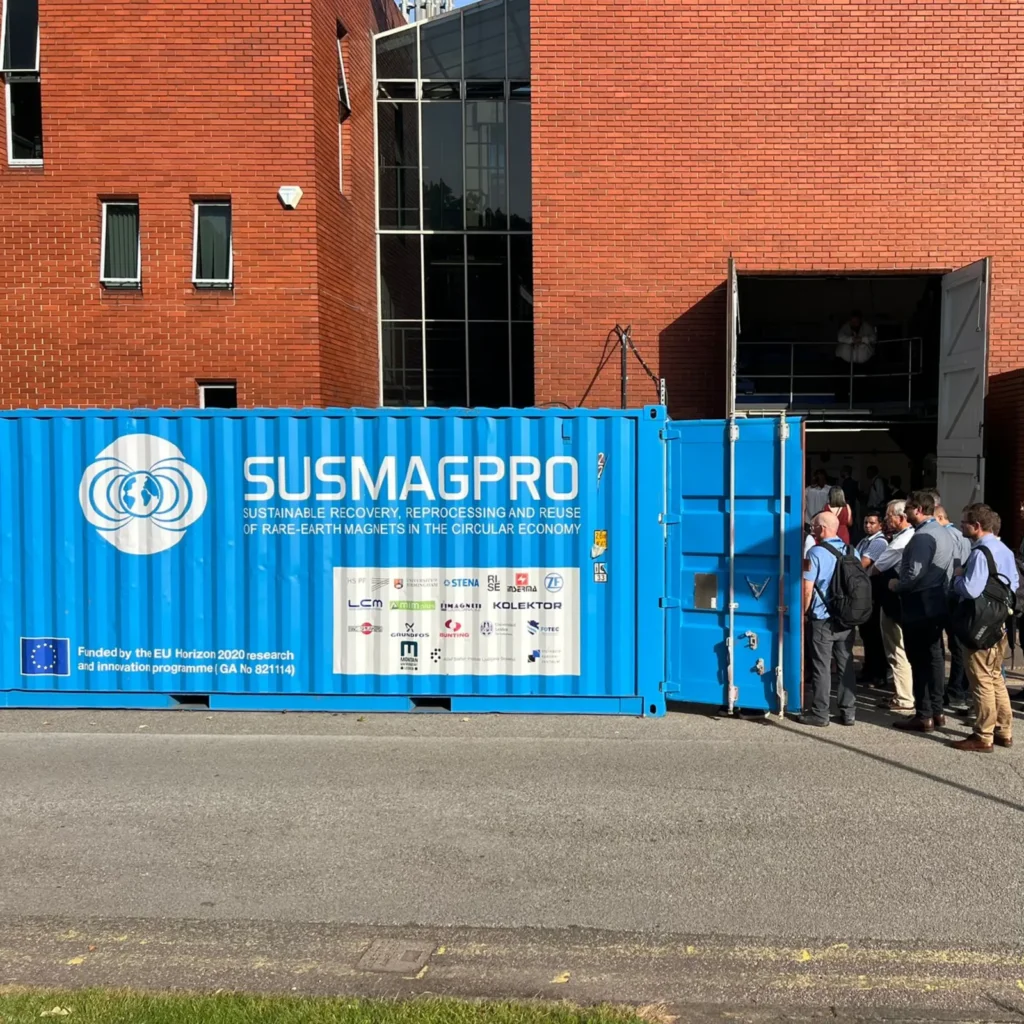
SUSMAGPRO (Sustainable Recovery, Reprocessing and Reuse of Rare-Earth Magnets in a Circular Economy) is a four-year research and innovation project funded by the European Union’s Horizon 2020 programme. It kicked off on 3 and 4 June 2019 in Pforzheim (Germany).
The project at a glance
- Duration: June 2019 to May 2023.
- Consortium: 19 partners from industry, academia and technology transfer, including Inserma Anoia.
- Countries: Austria, Denmark, Germany, Italy, the Netherlands, Slovenia, Spain, Sweden and the United Kingdom.
- Coordination: Prof. Carlo Burkhardt, of the Institute for Precious Metals and Technology at Pforzheim University.
- Grant agreement No. 821114.
What it aims to do
To develop a rare earth magnet recycling supply chain in Europe and demonstrate the new materials at pilot scale. Neodymium-iron-boron (NdFeB) magnets, which also contain dysprosium, are used in automotive, aerospace, e-mobility, power generation and consumer goods.
The project focuses on car rotors, water pumps, loudspeakers and wind turbines. It builds on two earlier projects: REMANENCE (7th Framework Programme), to detect and sort end-of-life products, and REProMag (Horizon 2020). It uses hydrogen-based technologies to separate and purify NdFeB powder.
Inserma’s role
Inserma worked on the separation and recovery stage and was responsible for part of the integration and automation of the developments, drawing on its experience in robotics and sorting machines: the systems that detect and separate the different fractions.
Paco Ortiz, of Inserma, summed up the challenge like this: dismantle the magnets and leave them in perfect condition for further treatment, in the shortest possible time and with as little handling as possible.
The roadshow
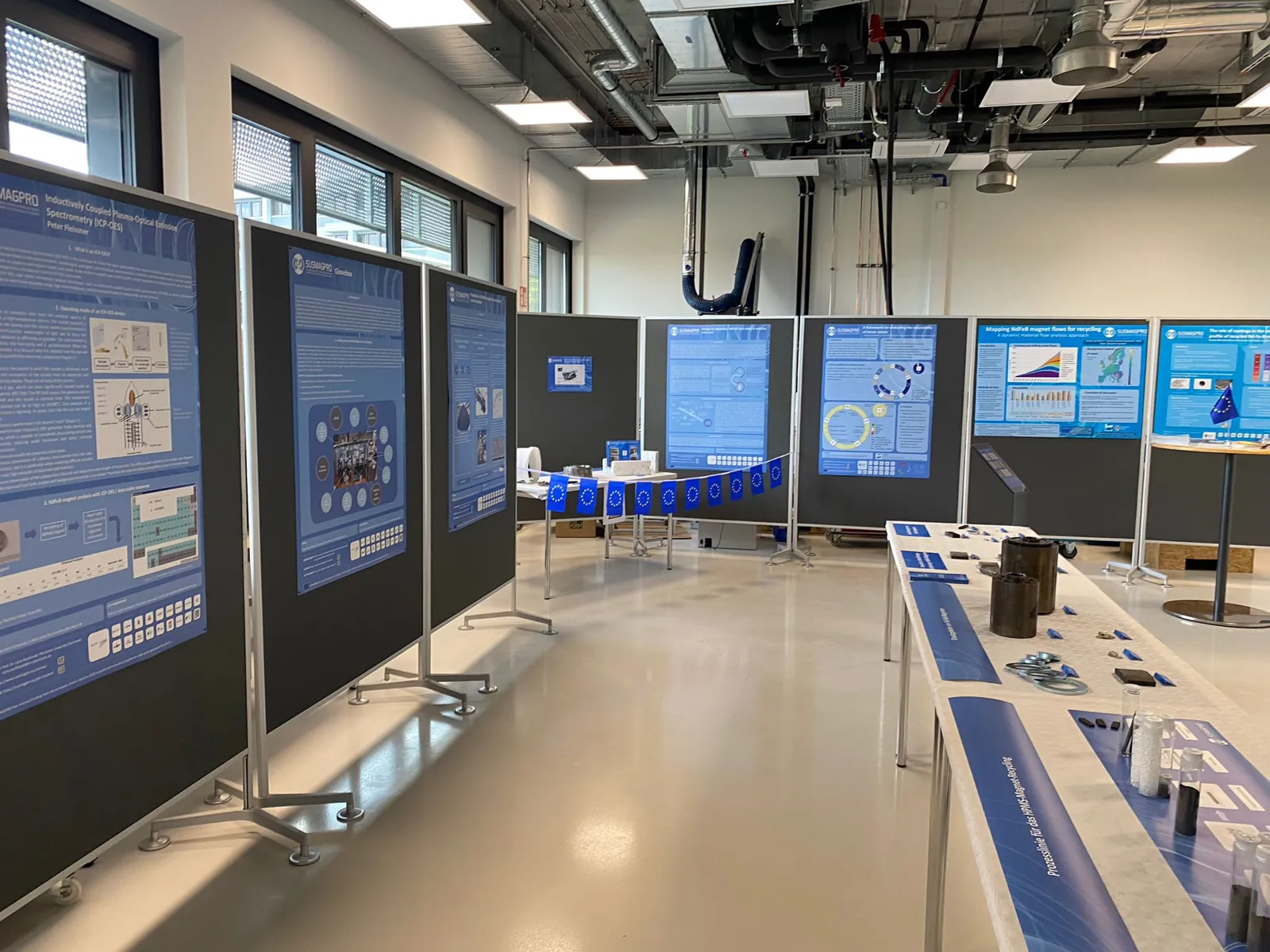
SUSMAGPRO brought rare earths closer to the public with an interactive roadshow through public spaces across Europe. The first stop was on 30 September 2021 at Pforzheim University. There, a pilot process from the project was shown: the automated separation of rare earth magnets from waste electrical and electronic equipment (WEEE).
In June 2022 the roadshow, with Inserma on board, reached Leiden University, as part of the Leiden European City of Science Festival 2022.
See Inserma’s other European projects. View projects and R&D
 29 January 2026REEsilience: a more resilient supply chain for rare earth magnets
 29 January 2026The University of Birmingham opens the UK’s first rare earth magnet recycling plant at Tyseley
 19 December 2025Inserma and CoTec Holdings: technology applied in the field